
Ride The Clutch Hoodie Drop
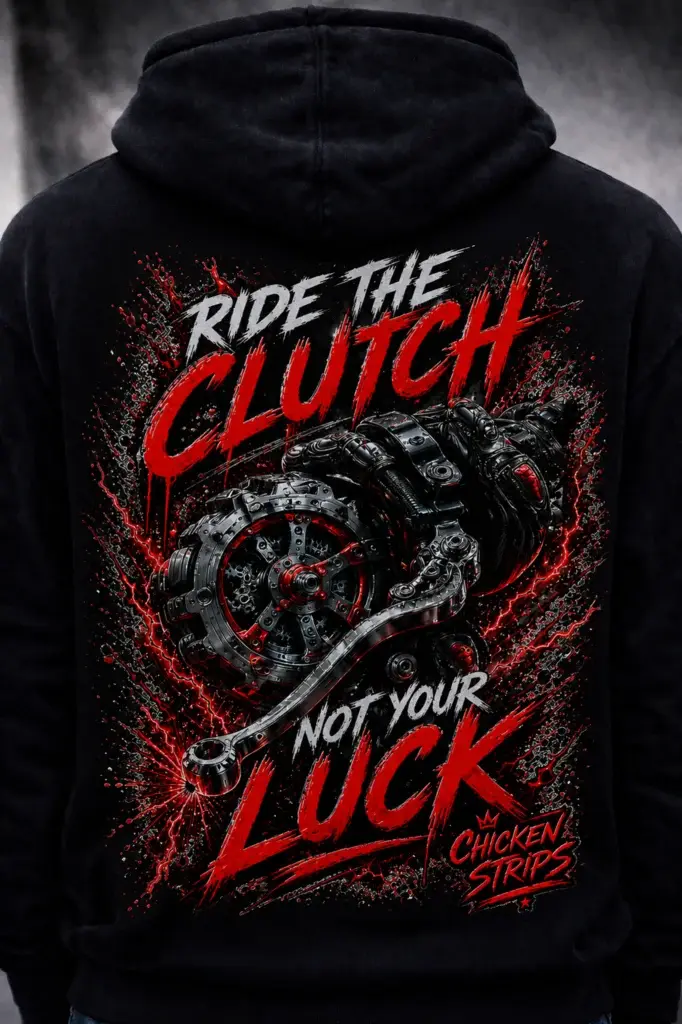
“Ride The Clutch” sounds like advice and an admission at the same time. Riders remember learning the bite point, stalling at the least convenient moment and concentrating so hard on one hand that the rest of the road disappeared. The phrase turns that shared awkwardness into humour without pretending a hoodie should teach control technique.
This archived drop is a design story. Motorcycle operation belongs to the owner's manual, formal training and qualified instructors. Current garment details remain on the product page.
The joke starts with a universal learning stage
Clutch control feels enormous when new and becomes almost invisible with practice. That contrast makes it useful rider humour. Experienced people recognise the memory; learners recognise the current task.
The design should invite them into the culture rather than mock a stall. Everybody began with conscious controls.
Wording stays deliberately ambiguous
“Ride the clutch” can describe an unhelpful mechanical habit, a slow-control moment or simply stubborn commitment. The ambiguity gives the wearer room to explain their own version.
It is not a maintenance recommendation. Excessive clutch slip can create wear or heat depending on the machine and situation, so exact guidance comes from manufacturer information and instructors.
A rider-specific phrase can stay wearable
Typography needs to communicate the joke quickly without surrounding it with diagrams. A small technical cue may support the idea, but too much literal hardware turns clothing into an instruction sheet.
The front/back arrangement lets the hoodie remain ordinary from one view and reveal the joke from another.
Sampling protects small detail
Clutch-related graphics often contain lines or small marks that can disappear on fabric. A physical sample checks contrast, edge quality and scale. It also shows how pocket, seams and hood alter the composition.
Approval should be based on the garment, not only a high-resolution design file.
Measure for comfort at stops
Use current product dimensions and compare them with a hoodie already worn in the desired fit. Do not assume all motorcycle clothing follows one sizing convention.
Consider how it will be used—at training, a cafe, garage conversation or ordinary day—and allow appropriate layering without guessing.
Keep the protection distinction obvious
The hoodie is casual clothing unless the exact product states protective certification. The clutch joke does not create abrasion resistance, impact protection or weather performance.
Wear suitable protective equipment for riding and ensure casual layers do not interfere with operation or fit.
Give it to learners without gatekeeping
As a gift, the phrase can celebrate completing training or surviving the first week with a new bike. It should not embarrass somebody about a skill they are still developing. Add a supportive note and avoid making the present a public test.
Check their size and humour. Inside jokes work only when the recipient is inside them.
Production still needs exact information
If printed to order, the garment moves through picking, artwork, production, checking and packing. Read the current estimate. Personalised details require a proof and can affect returns.
An event date or birthday does not bypass quality control or carrier variables.
Look after the printed garment
Follow the care label and avoid high heat or chemicals not approved for the fabric and print. Do not wear loose casual clothing during workshop tasks where it may catch on machinery.
Clean riderwear lasts longer and keeps the joke readable.
Learning becomes culture
Ride The Clutch works because motorcycle communities are built partly from remembered mistakes. The best experienced riders can laugh about them without pretending they never happened.
The hoodie preserves that shared stage as a grin, not a lesson. Actual skill still comes from patient practice, appropriate training and a motorcycle operated within its instructions.
Make training part of the story
Compulsory basic training and further professional instruction give learners a controlled place to develop. Advice from friends can support confidence, but it should not conflict with the instructor or encourage practice in an unsuitable location. A stall is information, not a reason for somebody behind to apply pressure.
The design can mark that progression without claiming it is complete. Skilled riders continue learning throughout ownership.
Keep workshop interpretation safe
Clutch adjustment, fluid or cable work is model-specific and safety-relevant. Follow the exact service information or use a competent technician. The phrase is not permission to alter free play by feel, choose a random lubricant or continue with slipping, noise or changed engagement.
A joke remains enjoyable when it does not disguise a mechanical symptom.